
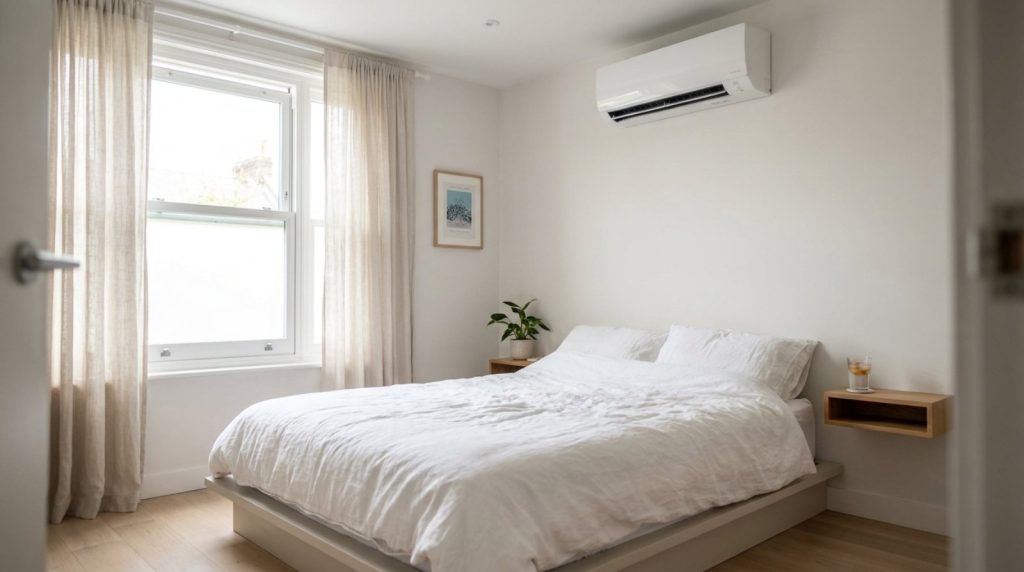
As a rule of thumb, allow 350 BTU per square metre of room, then round up to the nearest unit size: 7,000 BTU for up to 20m², 12,000 BTU for up to 35m², 18,000 BTU for up to 50m², and 24,000 BTU or more for anything larger. Use the full table below to match your room to an exact HeyBreeze unit, or read on for how to account for sunlight, ceiling height and occupancy.
BTU Calculator: Find Your Exact Size
Enter your room’s details below for a tailored BTU recommendation, based on the same 350 BTU/m² rule and adjustment factors explained in this guide.
Air Conditioner Size Guide: Room Size to BTU
This table is built directly from HeyBreeze's own product range, so every row links straight to units genuinely sized for that space — no guesswork.
| Room size | Recommended BTU | Example room | Shop |
|---|---|---|---|
| Up to 20m² | 7,000 BTU | Small bedroom, home office, box room | 7,000 BTU portable |
| Up to 25m² | 9,000 BTU | Double bedroom, small living room | 9,000 BTU wall-mounted |
| Up to 35m² | 12,000 BTU | Living room, open-plan kitchen-diner | 12,000 BTU wall-mounted |
| Up to 40m² | 13,648 BTU | Larger open-plan space, small shop | 13,648 BTU ceiling cassette |
| Up to 50m² | 18,000 – 18,766 BTU | Large open-plan living/kitchen, home extension | 18,000 BTU ceiling cassette |
| Up to 70–80m² | 24,000 – 27,297 BTU | Small office, retail unit, large open-plan floor | 24,000 BTU commercial cassette |
| Up to 125m² | 43,675 BTU | Large commercial space, restaurant, open-plan office | 43,675 BTU ceiling cassette |
How to Calculate BTU for Your Room
Measure your room's length and width in metres and multiply them to get the floor area in m². Multiply that figure by 350 to get a baseline BTU requirement, then round up to the nearest unit size in the table above — never round down. For example, a 4m × 5m bedroom is 20m², so 20 × 350 = 7,000 BTU, right at the top of the smallest unit's range. If your room measures 22m², round up to the 9,000 BTU tier rather than trying to stretch a 7,000 BTU unit further than it's rated for.
Factors That Increase Your BTU Requirement
The 350 BTU/m² baseline assumes a standard UK room: 2.4m ceiling height, average insulation, and normal occupancy. Add extra capacity for any of the following:
- High ceilings — add roughly 10% BTU for every 0.3m above the standard 2.4m, since you're cooling more air volume, not just floor area.
- South-facing rooms or large windows — add 10–20% for rooms that get direct sun for most of the day, especially with single glazing.
- More than 2 occupants — add roughly 600 BTU per additional person, since body heat adds a real cooling load in a small space.
- Kitchens or rooms with heat-generating equipment — add around 4,000 BTU for a kitchen, or extra capacity for rooms with servers, multiple monitors, or other electronics that run hot.
- Older, poorly insulated UK homes — solid-wall Victorian and Edwardian properties lose the cooling battle faster than modern insulated builds, so size up a tier if your home falls into this category.
- Top-floor or loft rooms — heat rises, and a room directly under an uninsulated roof will need more cooling capacity than an identical room lower down.
Room-by-Room Recommendations
Bedroom
Most UK bedrooms fall in the 10–20m² range, so a 7,000–9,000 BTU portable unit is usually enough. For a bedroom, also prioritise a quiet unit — look for 45dB or below so it won't disturb sleep.
Home Office
A home office is typically similar in size to a bedroom, but factor in extra heat from a computer, monitors and any additional equipment — size up to the 9,000 BTU tier if the room runs on the smaller side but is packed with electronics.
Living Room
Living rooms and open-plan lounges tend to run 20–35m², putting most in the 9,000–12,000 BTU range. A wall-mounted split system is the better long-term choice here since it's quieter and more efficient than a portable unit for a room you use every day.
Open-Plan Kitchen-Diner
Combine the floor area of the whole open-plan space, then add roughly 4,000 BTU on top for the cooking heat load. A 30m² open-plan kitchen-diner, for example, often needs an 18,000 BTU unit rather than the 12,000 BTU a straight area calculation would suggest.
Small Commercial or Retail Space
Shops, small offices and restaurants typically need 24,000 BTU or more, and benefit from a ceiling cassette system for even airflow across the space. HeyBreeze's professional installation service is F-Gas registered and can advise on multi-unit setups for larger commercial floors.
What Happens If You Choose the Wrong Size
Too small: the unit runs constantly at full power, struggles to ever reach the target temperature, uses more electricity than a correctly-sized unit would, and wears out faster from non-stop operation.
Too large: an oversized unit cools the room quickly but shuts off before it's had time to properly dehumidify the air, leaving the room feeling cold and clammy at the same time. It also short-cycles — switching on and off repeatedly — which is harder on the compressor and wastes money on a bigger unit than you needed.
Frequently Asked Questions
What size air conditioner do I need for a bedroom?
Most UK bedrooms need a 7,000–9,000 BTU unit. Measure the room in m² and multiply by 350 to confirm — a 15m² bedroom needs roughly 5,250 BTU, which rounds up to a 7,000 BTU unit.
Do I need a bigger air conditioner for a kitchen?
Yes. Add around 4,000 BTU on top of the standard area-based calculation to account for heat from cooking appliances, ovens and hobs.
Can one air conditioner cool multiple rooms?
A single split or portable unit is only rated to cool the one room it's installed in. For multiple rooms, either size a ceiling cassette for a genuinely open-plan space, or install a separate unit per room — trying to cool a hallway and closed-off rooms with one unit rarely works well.
Does ceiling height affect what size I need?
Yes. The 350 BTU/m² rule assumes a standard 2.4m ceiling. For higher ceilings, add roughly 10% BTU for every extra 0.3m, since you're cooling a larger volume of air, not just the floor area.
Is it better to size up "just in case"?
No. An oversized unit cools the air too fast to properly remove humidity, leaving the room feeling cold and damp rather than comfortable, and it short-cycles on and off in a way that's harder on the compressor. Size to the room, not "just in case."
How do I work out my room's square metres?
Measure the length and width of the room in metres with a tape measure and multiply them together. A 4m × 5m room is 20m². For an irregular-shaped room, split it into rectangles, calculate each area separately, and add them together.
Shop by Room Size
Browse the full HeyBreeze range by unit type: Portable Air Conditioners, Wall Mounted Split Systems, or Ceiling Cassette Units. Not sure which is right for your space? Our F-Gas registered installation team can survey your room and confirm the exact BTU you need before you buy.