
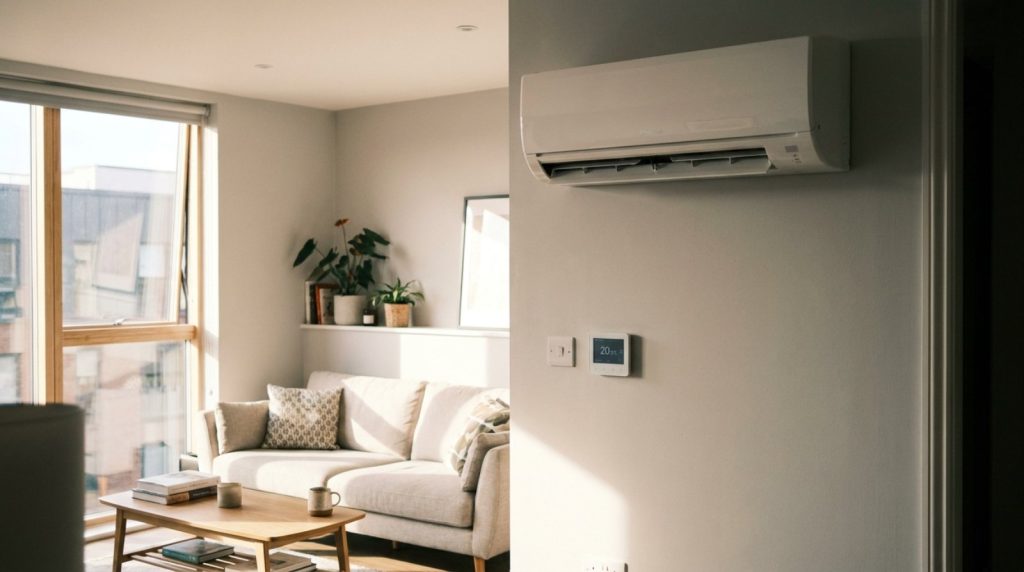
A typical 9,000 BTU wall-mounted air conditioner costs around 22p per hour to run at a standard UK electricity price of 27p/kWh — roughly £1.76 for an 8-hour night. Larger units cost more to run but cool more space, so the real question is matching the right size to your room rather than buying the cheapest-to-run unit. Use the table below for your exact BTU size, or read on for the full formula.
Air Conditioner Running Cost Calculator (by BTU)
These figures assume a modern A++ inverter unit (HeyBreeze and Gree units are R32 inverter models) and the UK average electricity price of 27p/kWh. Adjust up or down using your own tariff rate with the formula further down the page.
| Unit size | Input power | Cost per hour | Cost per 8hr night | Example unit |
|---|---|---|---|---|
| 7,000 BTU | 0.64 kW | 17p | £1.38 | 7,000 BTU portable |
| 9,000 BTU | 0.82 kW | 22p | £1.76 | 9,000 BTU wall-mounted |
| 12,000 BTU | 1.10 kW | 30p | £2.38 | 12,000 BTU wall-mounted |
| 13,648 BTU | 1.25 kW | 34p | £2.70 | 13,648 BTU ceiling cassette |
| 18,000 BTU | 1.65 kW | 45p | £3.56 | 18,000 BTU ceiling cassette |
| 24,000 BTU | 2.20 kW | 59p | £4.75 | 24,000 BTU commercial cassette |
| 43,675 BTU | 4.00 kW | £1.08 | £8.64 | 43,675 BTU ceiling cassette |
Not sure which BTU size fits your room? See our full air conditioner size guide before working out running costs — an undersized unit run at full power constantly can end up costing more than a correctly-sized one run normally.
How to Calculate Your Own Running Cost
Running cost per hour = input power (kW) × your electricity price per kWh. Find the input power on the unit’s spec sheet or energy label — not the BTU cooling output, which is a different number. For example, a unit with a 1.1 kW input power on a 27p/kWh tariff costs 1.1 × 27p = 29.7p per hour, rounded to 30p. If your tariff is 30p/kWh instead, the same unit costs 1.1 × 30p = 33p per hour.
Why Input Power Isn’t the Same as BTU
BTU measures the cooling output of a unit — the heat it removes from a room per hour. Input power (kW) measures the electricity it consumes to do that. The ratio between the two is the unit’s efficiency, expressed as EER (Energy Efficiency Ratio) or SEER for seasonal average. A modern A++ rated inverter unit typically has an EER around 3.2–3.6, meaning it moves 3.2–3.6 units of heat for every 1 unit of electricity it uses — which is why air conditioning is usually far cheaper to run than older resistive electric heaters, even though both are electric.
Factors That Change Your Real Running Cost
- Inverter vs non-inverter — inverter units (all HeyBreeze and Gree models) adjust their compressor speed to maintain temperature efficiently, rather than switching fully on and off. This uses significantly less electricity over a full day than an older non-inverter unit of the same BTU rating.
- Thermostat setting — each 1°C lower you set the target temperature increases running cost by roughly 3-5%, since the unit has to work harder to maintain a bigger gap from room temperature.
- Correct sizing — an undersized unit runs at maximum power almost constantly and still struggles, often costing more over a full night than a correctly-sized unit cycling normally. See our size guide to check your BTU requirement first.
- Insulation and room sealing — an open window or poorly insulated room forces the unit to keep re-cooling air that’s escaping or being reheated, increasing runtime and cost regardless of the unit’s efficiency rating.
- Your actual electricity tariff — the table above uses 27p/kWh as a UK average; check your own bill for your actual per-kWh rate, especially if you’re on a time-of-use or economy tariff where night rates may be lower.
Portable vs Wall-Mounted vs Ceiling Cassette: Running Cost Compared
For the same BTU rating, a portable air conditioner generally costs slightly more to run than an equivalent wall-mounted split system, because portable units lose some efficiency drawing in and exhausting air through a hose rather than exchanging directly with outside air via a properly sited outdoor compressor. Ceiling cassette systems are typically the most efficient per BTU for larger open-plan spaces, since their 4-way airflow cools a room evenly without the unit having to overcompensate for cold or warm spots.
5 Ways to Reduce Your Air Conditioning Running Costs
- Set a realistic target temperature — 21-24°C keeps a room comfortable without the unit fighting a large temperature gap. Every degree colder adds meaningfully to your running cost.
- Close doors, windows and curtains — keep cooled air in and direct sunlight out, especially in south-facing rooms during the day.
- Use timer and eco modes — run the unit only when the room is occupied, and let inverter/eco modes maintain temperature rather than running at full power continuously.
- Clean or replace filters regularly — a blocked filter forces the unit to work harder for the same cooling effect, increasing both running cost and wear.
- Size the unit correctly for the room — this is the single biggest factor. See our BTU size guide before buying.
Frequently Asked Questions
How much does it cost to run an air conditioner per night in the UK?
A 9,000 BTU wall-mounted unit costs around £1.76 for an 8-hour night at 27p/kWh. A larger 18,000 BTU unit costs around £3.56 for the same 8 hours. Multiply the unit’s input power in kW by your electricity price per kWh, then by the hours run.
Is air conditioning expensive to run in the UK?
Modern inverter air conditioning is generally cheaper per hour than most people expect — a typical bedroom unit costs 17-30p per hour, similar to or less than running an electric fan heater. The main driver of a high bill is running an undersized or poorly maintained unit continuously rather than the technology itself.
Does a bigger air conditioner cost more to run?
Yes, a bigger unit draws more input power per hour. However, an undersized unit for the room can end up costing more overall because it has to run at maximum power almost constantly and still struggles to reach temperature — correct sizing usually beats simply choosing the cheapest-rated unit.
What’s the difference between BTU and kW for running costs?
BTU measures cooling output, not electricity use. Input power in kW is what determines your running cost. Divide the BTU figure by 3,412 to get cooling kW, then divide by the unit’s EER (typically 3.2-3.6 for a modern inverter unit) to estimate input power in kW.
Does an inverter air conditioner really save money?
Yes. Inverter units adjust compressor speed to maintain temperature rather than repeatedly switching fully on and off, which uses less electricity over a full day of use than an older non-inverter unit of the same BTU rating.
Shop Air Conditioning by Running Cost
All HeyBreeze and Gree units are R32 inverter models built for efficient running costs. Browse by type: Portable Air Conditioners, Wall Mounted Split Systems, or Ceiling Cassette Units. Not sure what size you need first? Check our room size to BTU guide.