

Educational institutions across the UK face growing challenges in maintaining comfortable, safe, and productive learning environments. Rising summer heat events, coupled with stringent air-quality standards, mean that traditional natural ventilation often falls short. Modern HVAC (Heating, Ventilation, and Air Conditioning) technology—incorporating heat recovery, HEPA filtration, and smart inverter heat pumps—delivers year-round climate control while minimising energy consumption.
If your school, college, or university requires air conditioning, don’t hesitate to reach out to us today. We are dedicated to fulfilling all your needs and requirements.
Core Requirements: Compliance & Environmental Standards
Educational estate managers must meet several critical standards when specifying climate control equipment:
- Building Bulletin 101 (BB101): Sets strict targets for ventilation rates, CO₂ levels, and thermal comfort in school teaching spaces.
- DfE Air Quality Targets: Emphasises maintaining CO₂ levels below 800–1,000 ppm in classrooms to support cognitive function and reduce viral transmission risks.
- CIBSE TM52 / TM59: Guidelines for assessing overheating risks in UK educational and residential institutions.
- Decarbonisation Goals: Air-to-air heat pump technology directly aligns with Public Sector Decarbonisation Schemes (PSDS) by eliminating reliance on fossil-fuel heating.
Air Conditioning for Schools (Primary & Secondary)
Maintaining optimal indoor temperatures in primary and secondary classrooms is essential for pupil concentration and overall health.
Key Challenges:
- Compact classroom footprints with high occupancy density.
- Low noise tolerance to avoid disrupting lessons.
- Budget constraints and strict energy usage parameters.
Recommended Systems:
- Wall-Mounted Heat Pumps: Cost-effective, quiet (often operating under 21 dB(A)), and fast to install with minimal disruption.
- Ceiling Suspended / 4-Way Cassettes: Ideal for larger, open spaces like assembly halls, staffrooms, and school libraries, distributing air evenly across large areas.
- MVHR Integration: Mechanical Ventilation with Heat Recovery continuously replaces stale indoor air with fresh, filtered outdoor air while capturing heat or cool air before it escapes.
Air Conditioning for Colleges (FE & Sixth Form)
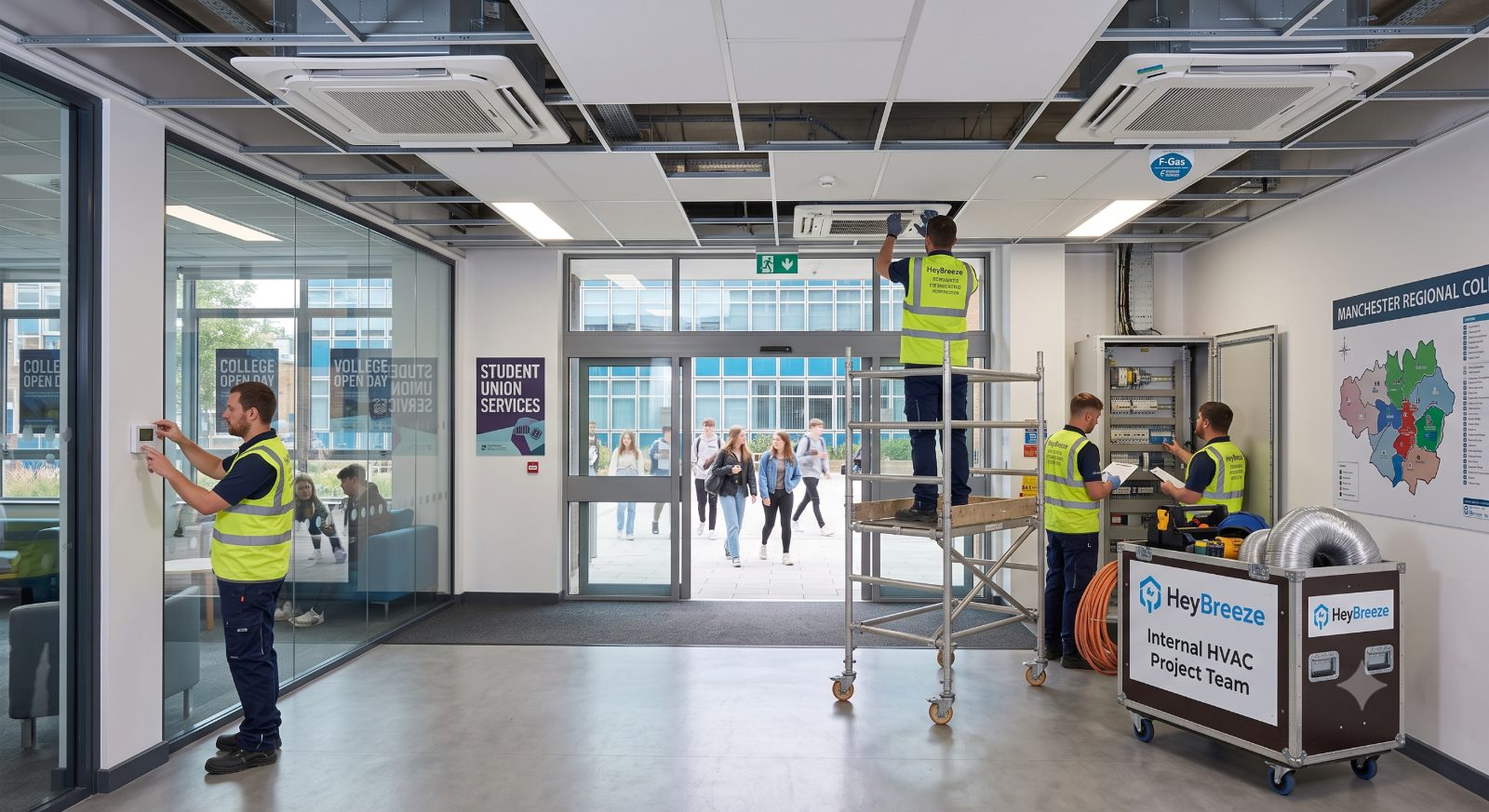
Further Education (FE) colleges demand versatile solutions capable of adapting to varied room types—from high-density IT suites to expansive lecture halls and vocational workshops.
Key Challenges:
- High thermal loads generated by computers, server racks, and specialist equipment.
- Varied room layouts requiring zoned, flexible climate control.
- Heavy footfall throughout long operating hours.
Recommended Systems:
- Multi-Split Systems: Connect multiple indoor units to a single outdoor unit, allowing distinct temperature zones across adjacent classrooms and IT labs.
- Precision Cooling for Server Rooms: Dedicated, high-reliability cooling units that operate 24/7 to safeguard college digital infrastructure.
- Smart Centralized Controls: Allow estate teams to schedule, monitor, and restrict temperature adjustments remotely, preventing unnecessary energy draw outside operating hours.
Air Conditioning for Universities & Higher Education Estates
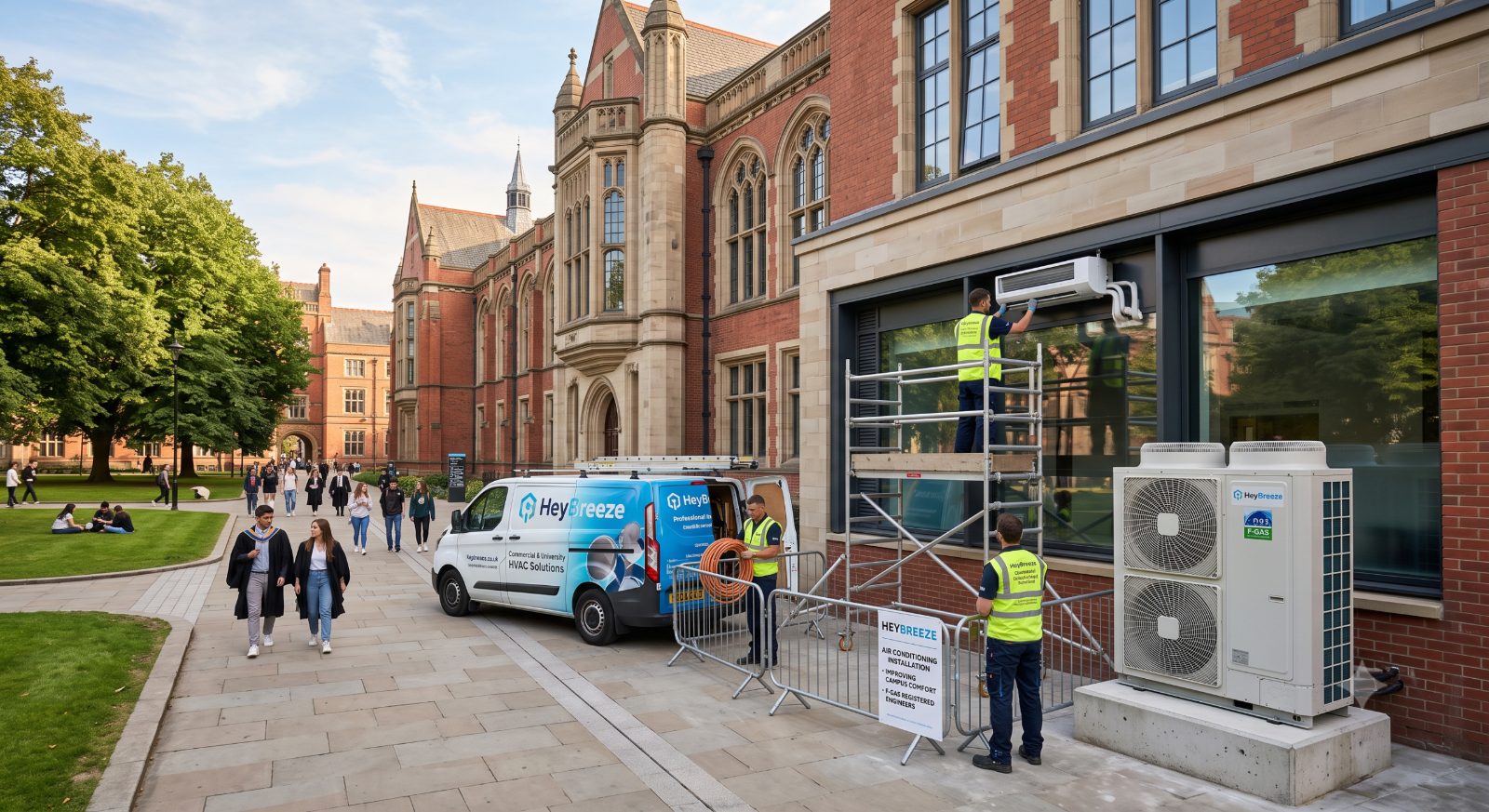
University campuses feature complex multi-building estates with diverse cooling and heating requirements, from large lecture theatres and science laboratories to student accommodation blocks.
Key Challenges:
- Massive energy footprints across spread-out campus facilities.
- Simultaneous heating and cooling requirements in different zones of the same building.
- High emphasis on achieving BREEAM accreditation and net-zero targets.
Recommended Systems:
- VRF / VRV Heat Recovery Systems: Advanced 3-pipe systems that simultaneously heat zones on the cold side of a building while cooling zones exposed to solar heat gain. Heat energy extracted from cooled spaces is repurposed to warm other areas or heat domestic water.
- Ducted Concealed HVAC Units: Installed seamlessly into ceiling voids, preserving architectural aesthetics in historical campus buildings while delivering high airflow volume at minimal noise levels.
- BMS (Building Management System) Integration: Full protocol compatibility (BACnet, Modbus) for central tracking, predictive maintenance, and floor-by-floor energy sub-metering.
System Comparison Matrix
| Feature / Criteria | Primary & Secondary Schools | Colleges (FE & Sixth Form) | University Estates |
| Primary System Type | Wall-Mounted / Cassette | Multi-Split & Cassette | VRF Heat Recovery & Central Ducted |
| Occupancy Focus | Single Classrooms (20–30 pupils) | Mixed-use Labs & IT Suites | Large Lecture Halls & Campus Buildings |
| Key Metric | Low Noise & DfE CO₂ Compliance | Flexible Zoning & IT Heat Removal | Energy Recovery & BMS Integration |
| Funding Pathways | CIF (Condition Improvement Fund) | PSDS & Devolved Capital | PSDS & Institutional Capital Budgets |
Key Benefits of Modern Education Climate Control
- Enhanced Learning Performance: Studies demonstrate a direct link between lower indoor temperatures/CO₂ levels and improved test results and pupil alertness.
- Year-Round Energy Efficiency: Reverse-cycle heat pumps deliver up to 4 kWh of heat for every 1 kWh of electricity consumed (SEER / SCOP ratings exceeding 4.0).
- Improved Air Quality: Advanced filtration captures pollen, dust, particulate matter ($PM_{2.5}$), and airborne contaminants, promoting healthier learning spaces.
Frequently Asked Questions
What funding is available for school air conditioning and ventilation upgrades in the UK?
Academy trusts and FE colleges can apply for funding through schemes such as the Condition Improvement Fund (CIF) and the Public Sector Decarbonisation Scheme (PSDS), which support projects replacing fossil-fuel heating with low-carbon heat pump solutions.
How do air conditioning systems help meet DfE ventilation guidelines?
Modern commercial HVAC systems are combined with mechanical supply and extract ventilation (MVHR) to bring in fresh, filtered air, keep CO₂ levels below 1,000 ppm, and maintain comfortable temperatures without relying solely on open windows in winter or peak summer.
What is the quietest air conditioning option for a classroom?
Modern wall-mounted or ceiling-ducted split systems designed for educational spaces operate as quietly as 19–22 dB(A), which falls well within the strict background noise guidelines set out in Building Bulletin 93 (BB93).