
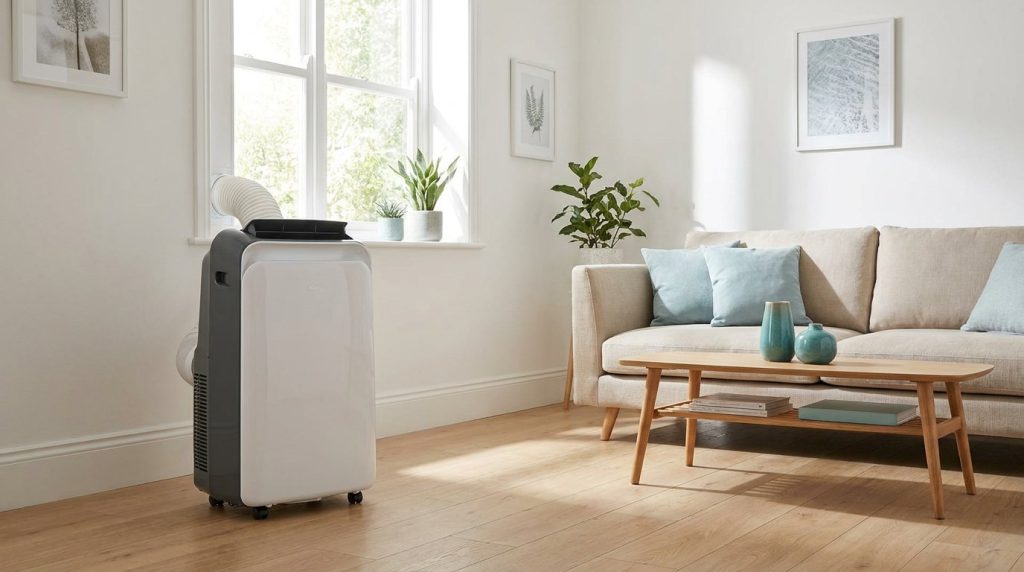
A portable air conditioner is a self-contained cooling unit that stands on the floor of any room, needs no permanent installation, and vents hot air outside through a window using a flexible exhaust hose. They’re the fastest way to cool a UK home in a heatwave — no engineer visit, no drilling, and most units are cooling a room within minutes of being unboxed.
What Is a Portable Air Conditioner?
Unlike a split system, which has an indoor unit permanently fixed to a wall and an outdoor compressor, a portable air conditioner combines everything into one wheeled unit you can move between rooms. It draws in warm room air, cools it, and expels the extracted heat and moisture through an exhaust hose routed out of a nearby window. Most models also work as a dehumidifier, and some double as a fan in cooler weather.
How Many BTU Do I Need for a Portable Air Conditioner?
As a rule of thumb, allow around 350 BTU per square metre of room, then adjust upward for high ceilings, south-facing windows, or rooms with a lot of electronics. Undersizing is the most common mistake — a unit that’s too small will run constantly and still struggle to cool the room.
| Room size | Recommended BTU | Example room |
|---|---|---|
| Up to 20m² | 7,000 BTU | Bedroom, home office, single room |
| Up to 25m² | 9,000 BTU | Larger bedroom, small living room |
| Up to 35m² | 12,000 BTU | Living room, open-plan kitchen |
| 35m²+ | 18,000 BTU or more | Large open-plan or commercial space |
Portable AC vs Split System — Which Is Right for You?
Choose a portable air conditioner if you rent your home, need cooling installed today rather than in a few weeks, or only need to cool one room at a time. Choose a wall-mounted split system if you want permanent, quieter, more efficient cooling for a room you use year-round and you’re able to have it professionally installed. Portable units are typically 15-20dB louder than an equivalent split system, since the compressor sits in the room with you rather than outside.
Key Features to Look For
Noise Level
Portable air conditioners typically run between 45dB and 65dB. For a bedroom, look for a unit rated 45dB or below — anything louder is noticeable enough to disturb sleep. Larger, more powerful units are almost always louder, so don’t oversize a unit for a small room just for the sake of it.
Dehumidifier Function
Most portable units remove moisture from the air as a side effect of cooling. Some go further with a dedicated 3-in-1 mode that lets you run dehumidification alone, without the compressor working at full power — useful on humid but not especially hot days, and cheaper to run.
Venting Requirements
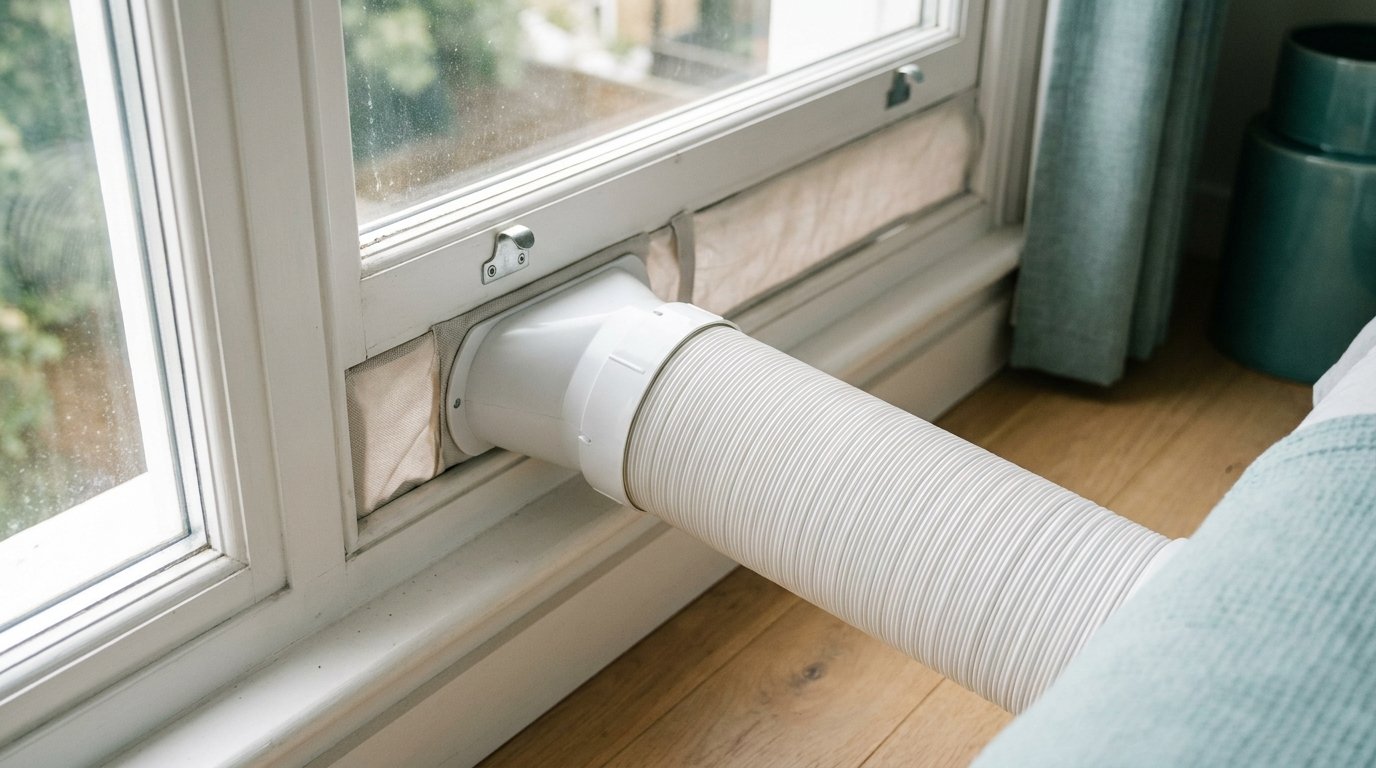
Every portable air conditioner needs to vent hot air outside, almost always through a window using the supplied exhaust hose and window kit. The window doesn’t need to stay fully open — window kits seal around the hose so only a small gap is needed. Without venting, the unit will just recirculate the heat it’s extracting back into the room.
Energy Efficiency
Portable units are generally less efficient than split systems because energy is lost through the exhaust hose and the compressor generates heat inside the room it’s cooling. Look for the energy label rating and a lower wattage draw relative to BTU output if running costs matter to you.
Our Recommended Portable Air Conditioners
HeyBreeze Compact 7000 BTU — our bedroom specialist. 7,000 BTU, covers rooms up to 20m², whisper-quiet at 45dB, with sleep mode and a washable filter. Best for bedrooms, home offices, and single rooms where noise matters most.
HeyBreeze Elite 12000 BTU — our most capable portable unit. 12,000 BTU, covers rooms up to 35m², with a genuine 3-in-1 dehumidifier mode, 24-hour programmable timer, and easy-roll castors. Best for living rooms and open-plan spaces.
See the full range on our Portable Air Conditioners page, with live filtering by room size, cooling power, and features.
Running Costs — What Does It Cost to Run a Portable AC?
A typical 7,000 BTU portable air conditioner draws around 700-900W. Running for 8 hours a day at current UK electricity prices costs roughly £1.50-£2 per day, depending on your tariff and how hard the unit has to work. Larger 12,000 BTU+ units draw more, typically £2.50-£3.50 per day for the same usage pattern. Running the unit only when you’re in the room, and closing curtains during the hottest part of the day, meaningfully reduces this.
Frequently Asked Questions
Do portable air conditioners actually work?
Yes. A correctly sized, properly vented portable air conditioner will noticeably cool a room, typically by 5-10°C from the outdoor or pre-cooling temperature. The most common cause of disappointing performance is an undersized unit or a poorly sealed window vent letting warm air back in.
Do I need to leave a window open?
Only enough to fit the exhaust hose through the supplied window kit — usually a gap of a few centimetres, which the kit seals around. You don’t need the window open wide.
How long do portable air conditioners last?
With normal seasonal use and basic maintenance — mainly cleaning or replacing the filter — a good-quality portable air conditioner typically lasts 8-10 years.
Can I use a portable air conditioner without venting it outside?
No. Portable air conditioners work by extracting heat from the room and expelling it outside through the exhaust hose. Running one without venting it will not cool the room — the heat it removes from the air gets pumped straight back out the rear of the unit.
Are portable air conditioners noisy?
They’re louder than split systems, since the compressor is in the room with you, but a well-designed unit rated around 45dB is comparable to a quiet conversation and suitable for bedrooms. Always check the noise rating in the specification before buying if you’re sensitive to it.
Portable Air Conditioning Units – Cool Comfort Anywhere, Anytime
Stay cool, comfortable, and in control with a portable air conditioning unit. These versatile, self-contained cooling systems deliver powerful, targeted relief without the need for permanent installation. Ideal for apartments, bedrooms, offices, garages, server rooms, or any space where traditional window or central AC isn’t practical.
Why Choose a Portable Air Conditioner?
- Easy setup & mobility: Simply roll it into place, vent the exhaust hose, and enjoy instant cooling. Most models feature smooth-rolling casters and compact designs that fit through standard doorways.
- No permanent installation: Perfect for renters, temporary spaces, or homes without ductwork. Avoid the cost and hassle of window units or professional HVAC work.
- Flexible cooling: Many units offer cooling, fan-only, and dehumidifying modes so you can customize comfort based on the weather and your needs.
- Energy-conscious options: Look for Energy Star–rated or inverter models that deliver efficient cooling while helping keep electricity costs in check.
- Quiet operation: Modern portable ACs are engineered for lower noise levels, making them suitable for bedrooms and workspaces.
Key Features to Look For
- BTU capacity matched to room size – Choose the right cooling power (typically 8,000–14,000 BTU for most rooms) for effective performance without wasting energy.
- Self-evaporative technology – Reduces the need for frequent water tank emptying by recycling moisture.
- Smart controls – Remote, LED displays, programmable timers, sleep modes, and some models with Wi-Fi or app connectivity.
- Washable filters – Easy maintenance for cleaner air and longer unit life.
- Multiple fan speeds and oscillation – Better air distribution throughout the room.
Benefits You’ll Feel Immediately
Portable air conditioning units provide fast, localized cooling that helps you sleep better, work more productively, and stay comfortable during heatwaves. They also help control humidity, which can make a space feel cooler and more pleasant while protecting furniture and electronics from excess moisture.
Whether you need a portable AC for a bedroom, living room, home office, or supplemental cooling in a larger home, these units offer a practical, affordable solution that moves with you.
Ready to Beat the Heat?
Shop high-performance portable air conditioning units designed for real-world comfort. Compare BTU ratings, energy efficiency, noise levels, and features to find the perfect match for your space. Enjoy cooler air, lower humidity, and greater flexibility—starting today.
Cool your space on your terms. Explore our range of portable air conditioners and stay comfortable all summer long.